
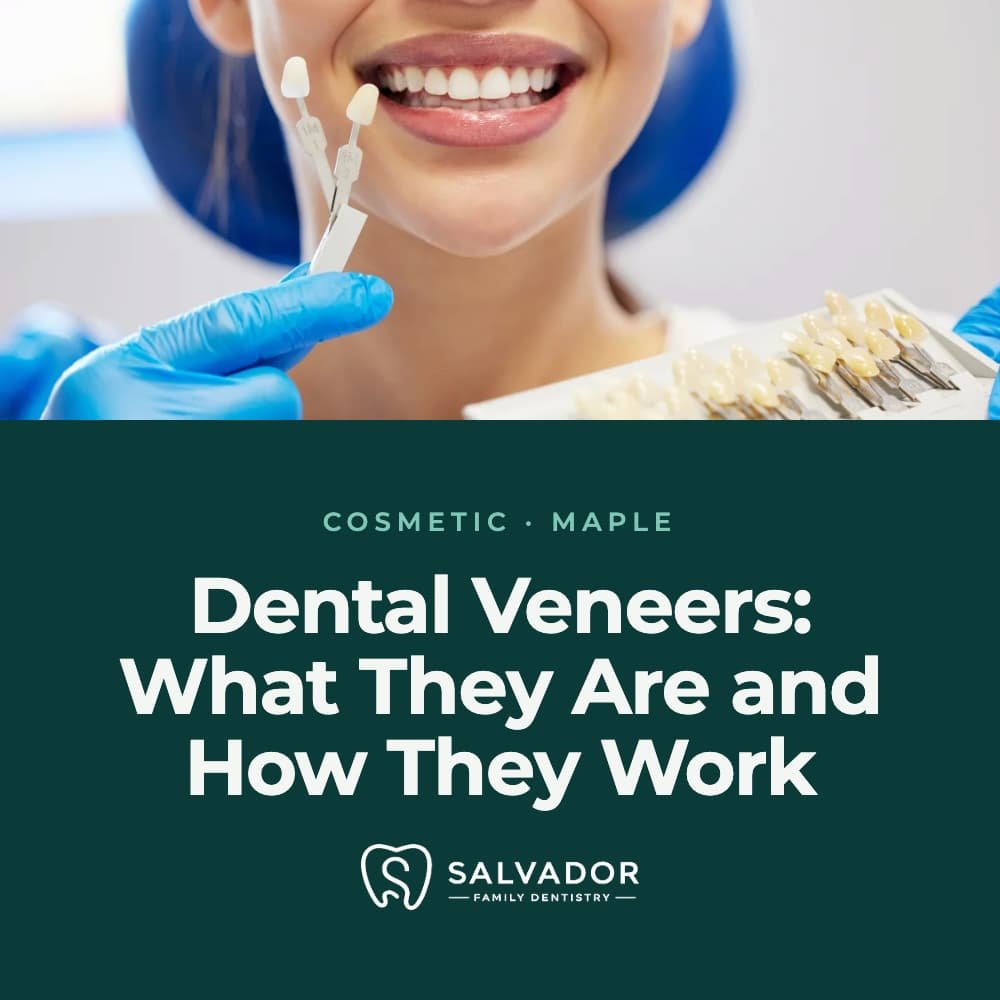
Veneers are one of the more commonly asked about cosmetic dental options, and it helps to understand what they actually are, what they can realistically fix, and what the decision involves before exploring further. At Salvador Family Dentistry, Dr. Luca Salvador is direct about this from the start, a veneer is a genuine, permanent commitment, not a temporary fix, and understanding that upfront matters more than any other single fact about them.
What Are Dental Veneers?
A veneer is a thin shell, usually made from porcelain or a composite resin, bonded to the front surface of a tooth. According to the Canadian Dental Association, veneers cover the entire front surface of the tooth and can change the colour, shape, spacing, or alignment appearance of teeth that are otherwise healthy, not just teeth that are damaged. Veneers are custom made to your mouth and shade matched to blend with your surrounding teeth, or to a shade agreed with your dentist. Veneer preparation is considered permanent, since a small amount of enamel is typically removed to prepare the tooth, and enamel does not grow back once removed, a point worth understanding from the outset. The American Dental Association describes veneers as a standard, well established cosmetic dentistry option.
What Can Veneers Actually Fix?
Veneers address a specific set of cosmetic concerns well, and understanding which category your concern falls into helps set realistic expectations before a consultation.
Common concerns and veneer suitability
| Concern | How Veneers Address It |
| Intrinsic staining | Discolouration from within the tooth, from tetracycline use, fluorosis, or developmental factors, does not respond to whitening. A veneer covering the surface addresses this directly. |
| Chips and minor cracks | Small chips on the edges or corners of front teeth are one of the more straightforward applications, restoring shape without extensive tooth reduction. |
| Small gaps | Minor spacing between front teeth can often be reduced or closed by widening adjacent teeth with a veneer, without orthodontic treatment. |
| Shape and proportion | Naturally undersized, irregularly shaped, or peg-shaped teeth can be built up for more consistent proportions across the smile. |
| Significant misalignment | Not addressed by veneers, which change appearance, not tooth position. Orthodontic treatment is the appropriate option here instead. A missing tooth is a different situation entirely, better addressed through dental implants rather than a veneer, since a veneer needs an existing tooth to bond to. |
Porcelain vs Composite Veneers
Both types of veneers are available at Salvador Family Dentistry, and the right choice depends on your goals, timeline, and budget.
Porcelain vs composite veneers
| Factor | Porcelain | Composite |
| Fabrication | Custom crafted in a dental lab, takes a few appointments | Applied directly in the chair, often same day |
| Durability and staining | More colour stable, longer lasting | Less colour stable, may need periodic touch-ups |
| Cost and repair | Higher cost, requires full replacement if damaged | Lower cost, repairable if chipped |
| Tooth preparation | Typically more preparation required | Minimal to no tooth reduction in most cases |
Common Reasons Patients Choose Veneers
Patients pursue veneers for a range of reasons, each a genuine, distinct motivation rather than a single universal one. To cover staining that whitening cannot reach, since intrinsic discolouration does not respond to bleaching treatments. To restore a chipped or worn tooth’s shape without the more extensive preparation a crown requires. To close small gaps or correct minor proportion issues without a multi-month orthodontic course. To achieve a more consistent, even smile line before a significant life event, when timeline matters as much as the result itself. Not every reason applies to every patient, and a consultation clarifies which, if any, genuinely fit your situation.
What Does the Veneer Process Involve?
At a high level, the process starts with a consultation where your dentist examines your teeth, discusses your goals, and confirms whether veneers are an appropriate fit. A small amount of enamel is then removed from the front of the tooth to make room for the veneer material, an irreversible step, followed by an impression or scan used to fabricate porcelain veneers, or direct application for composite. Once ready, the veneer is bonded permanently to the tooth, with fit, shade, and shape checked and adjusted before you leave. Our full veneers service page walks through this process in more specific detail.
Caring for Veneers at Home
Veneers do not require special products, brush and floss them exactly as you would natural teeth. If you grind your teeth at night, a custom nightguard is worth discussing, since the Canadian Dental Association notes that clenching and grinding can damage veneers over time. Avoid biting directly into very hard foods or objects like ice or fingernails with veneered teeth. Composite veneers in particular benefit from periodic professional polishing to manage surface staining, while porcelain holds its shade with routine hygiene alone.
Is a Veneer Reversible?
No, and this deserves clear emphasis. Because a small amount of enamel is removed to prepare the tooth, and enamel does not grow back, a tooth prepared for a veneer will always need some form of covering going forward, whether the original veneer or an eventual replacement. This does not make veneers a poor choice for the right situation, but it does mean the decision deserves real consideration rather than being treated as a low-commitment trial. We will not tell you veneers are reversible, that would not be honest, and we would rather you understand this clearly before a consultation than discover it partway through one.
What Should You Ask Before Getting Veneers?
A veneer is a genuine investment of time and money, worth a bit of extra thought before committing.
What to consider, and what to ask
| Consideration | What to Ask |
| Is my concern actually suited to a veneer | Would a different treatment, like orthodontics or a crown, address this better? |
| Porcelain or composite | Which fits my timeline, budget, and durability expectations? |
| Permanence | Am I genuinely comfortable with this being a lasting commitment? |
| Cost and coverage | Since veneers are cosmetic, what will this actually cost, and is any part covered? |
| Maintenance | Do I grind my teeth, and would a nightguard be part of the plan? |
Why Salvador Family Dentistry Fits
Dr. Luca Salvador, a general dentist with a focus in cosmetic dentistry, leads with an honest conversation about candidacy before any preparation begins, rather than a default recommendation for every cosmetic concern that walks through the door. Where a different option, clear aligners for alignment, or a crown for a structurally compromised tooth, would serve you better, that is what gets recommended instead. Coverage for cosmetic work like veneers is typically limited under most insurance plans, and we review your specific situation before you commit to anything.
Local Considerations for Maple Patients
Patients across Maple and Vaughan considering veneers often want a straightforward path from consultation to finished result without needing multiple providers for different stages. At Salvador Family Dentistry, both porcelain and composite options are handled at one Maple clinic, with same-day composite veneers available for straightforward cases.
As with any cosmetic decision, it is worth confirming current pricing and appointment availability directly with the clinic, since these details can change over time.
Frequently Asked Questions
Do veneers look natural?
Well-planned veneers are designed to complement your face and blend with your remaining natural teeth, not to look uniformly perfect in a way that reads as obviously cosmetic. Shade matching under different lighting and attention to proportion relative to your other teeth are both part of getting a result that looks like a better version of your own smile rather than an artificial one.
Are veneers permanent? Can they be removed?
Veneers are considered a permanent treatment because a small amount of enamel is removed during preparation, and enamel does not grow back once it is gone. This means that once a tooth has veneers, it will always need some form of covering going forward, whether the original veneer or an eventual replacement. It is a genuine long-term commitment, discussed clearly before any preparation begins.
Can veneers fix crooked teeth?
Not meaningfully. Veneers change the appearance of the front surface of a tooth, not its underlying position, so a rotated or significantly misaligned tooth will still read as misaligned beneath a veneer. Where straightening is the actual goal, orthodontic treatment or clear aligners are the more appropriate starting point, and in some cases the resulting alignment alone removes the need for veneers afterward.
How long do veneers last?
Porcelain generally lasts longer and resists staining better than composite, which is more affordable and repairable but may need periodic touch-ups. Actual lifespan for either material depends on your oral hygiene, whether you grind your teeth at night, and how well you avoid biting directly into very hard foods or objects with veneered teeth.
Does insurance cover veneers?
Most insurance plans classify veneers as a cosmetic procedure and do not cover them unless there is a functional reason, such as restoring a chipped or cracked tooth rather than a purely aesthetic concern. Coverage details vary meaningfully between plans, so confirming with your specific provider before committing to treatment is worth doing rather than assuming either way.
If there is something about your smile you have been thinking about changing, book a smile consultation with Salvador Family Dentistry in Maple.