
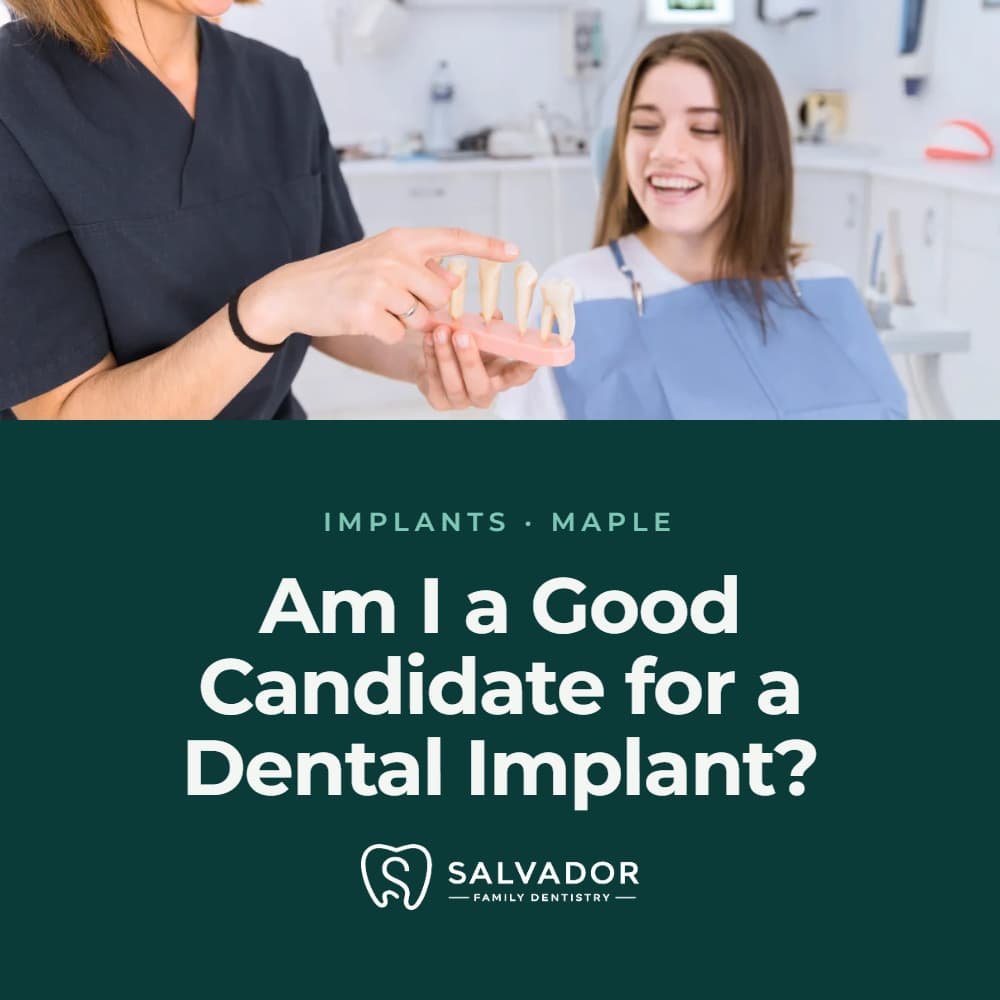
A good dental implant candidate generally has one or more missing teeth, healthy or manageable gums, adequate jawbone support, and sufficient overall health to support the procedure and healing process. This guide can help you understand what a dentist evaluates before recommending treatment, but only an in-person assessment, including a review of your oral health, jawbone condition and medical history, can confirm whether implants are right for you.
Quick-Answer Verdict
A good dental implant candidate generally has one or more missing teeth, healthy or manageable gums, adequate jawbone support and sufficient overall health for the procedure and healing process.
Bone loss, gum disease, smoking, or a medical condition does not always make someone permanently ineligible. Additional care or treatment may be needed before implant placement.
Dental implant eligibility depends on several individual factors, including oral health, medical history, medications, bone availability, and your ability to maintain good oral hygiene.
A dentist must perform an examination and review appropriate diagnostic images before confirming whether dental implants are suitable.
Patients who are not currently eligible may have preparatory treatment or alternative tooth-replacement options available.
Only a qualified dentist can determine whether you meet the relevant implant requirements. This guide can’t do that for you.
What Makes Someone a Dental Implant Candidate?
A dental implant candidate is generally someone who has one or more missing teeth and suitable oral and general health for implant placement and healing.
Common implant considerations include one or more missing teeth, healthy gums or gum disease that has been successfully managed, sufficient jawbone to support an implant, good plaque control and oral hygiene, general health that supports healing, realistic expectations about treatment, a commitment to follow-up appointments, willingness to maintain the implant and surrounding tissues, ability to undergo the recommended dental procedure, and your smoking status and willingness to reduce or stop tobacco use where advised.
Candidacy isn’t determined by one factor alone. Your dentist considers your complete oral and medical picture, and having sufficient bone or healthy gums doesn’t automatically mean you qualify; other factors matter too.
A dental implant candidate is generally an adult with one or more missing teeth, healthy or manageable gums, adequate jawbone support, and sufficient overall health for implant placement and healing. A dental examination and medical history review are required to confirm eligibility.
How Does a Dentist Evaluate Your Oral Health?
A dentist evaluates your oral health by examining your teeth, gums, bite, and the missing-tooth area, and by reviewing relevant diagnostic images.
The assessment may include a dental and medical history review, examination of the gums, evaluation for gum disease, assessment of remaining teeth, a review of tooth decay or active infection, examination of the missing-tooth area, evaluation of your bite, assessment of oral hygiene, dental X-rays, three-dimensional imaging when clinically appropriate, a review of jawbone height, width, and quality, a discussion of smoking or tobacco use, a review of medications and health conditions, evaluation of teeth grinding or clenching, and a discussion of your treatment goals and expectations.
Active decay, infection, or gum disease may need to be treated before implant placement, and imaging requirements depend on your individual case and your dentist’s clinical judgment.
How does a dentist determine whether you’re eligible for dental implants? Through this combination of clinical examination, imaging, and health-history review, not through a checklist you can complete on your own.
Does Bone Loss Affect Dental Implant Treatment?
Bone loss can affect dental implant eligibility because an implant requires adequate jawbone for initial placement and long-term support.
Bone may shrink after tooth loss, and long-term missing teeth can affect available bone volume. Gum disease may also contribute to bone loss over time. The position and amount of available bone matters, and diagnostic imaging helps your dentist assess the implant site (bone requirements vary according to the planned implant and restoration).
If bone volume is limited, depending on your needs, your dentist may discuss bone grafting, ridge preservation, ridge augmentation, sinus augmentation, a modified implant position, a different implant size or treatment approach, referral to an appropriate dental professional, or an alternative tooth-replacement option. Not every patient with bone loss will qualify for grafting or implant treatment. Bone density is one consideration, but bone volume, anatomy, health, and the planned restoration all factor in too.
Bone loss can affect dental implant treatment because the implant needs adequate jawbone support. However, bone loss does not always rule out treatment. A dentist may discuss grafting, a modified treatment plan, or another tooth-replacement option after examining the implant site.
How Do Gum Health and Existing Teeth Affect Candidacy?
Healthy gums and stable surrounding teeth matter because implants depend on healthy supporting tissues.
Gum-related factors include active gum disease, gum inflammation, bleeding gums, bone loss caused by periodontal disease, poor plaque control, a previous history of gum disease, and your ability to attend periodontal maintenance appointments.
Existing teeth and bite factors include untreated tooth decay, dental infections, cracked or failing teeth, problems affecting neighbouring teeth, bite alignment, teeth grinding or clenching, the space available for the planned restoration, and the condition of the opposing teeth.
Gum disease, tooth decay, and infection may need to be managed before an implant procedure begins. If you’re already dealing with any of these, our routine check-ups and cleanings can help address them as a starting point.
Gum disease, untreated decay, and dental infections can affect implant candidacy because they may interfere with healing and the health of the tissues supporting the implant. A dentist may recommend treating these conditions before proceeding.
What Health Conditions May Affect Dental Implant Treatment?
Certain medical conditions and medications may affect surgery, healing, or infection risk, but they don’t always make dental implants impossible.
Factors that may require additional assessment include uncontrolled diabetes, conditions that affect bone healing, immune-system disorders, bleeding disorders, certain cardiovascular conditions, previous radiation treatment involving the head or jaw, a history of significant healing complications, medications that affect bone metabolism, medications that affect bleeding, immunosuppressive medications, pregnancy (when elective treatment may need to be postponed), smoking, vaping or other tobacco use, heavy alcohol use where it may affect healing, and your ability to follow aftercare instructions.
Please provide your dentist with a complete list of your medical conditions, current medications, supplements, allergies, previous surgeries, previous complications involving anaesthesia or healing, and tobacco and alcohol use. Your dentist may need to communicate with your physician or another healthcare professional as part of this process. No single condition here automatically disqualifies every patient; it depends on how well it’s managed.
Health conditions that interfere with healing, immune function, bleeding control, or bone health may affect dental implant treatment. Eligibility depends on how well the condition is managed, the medications involved, and your individual risk assessment.
What Should You Expect Before Dental Implant Surgery?
Preparation depends on your oral health, medical history, and proposed treatment.
Attend a dental implant consultation. Your dentist reviews your concerns, missing teeth, treatment goals, and general expectations.
Complete an oral examination. Your teeth, gums, bite, and missing-tooth area are examined for conditions that could affect treatment.
Review your medical history and medications. Your dentist checks for health conditions, medications, and lifestyle factors that may influence surgery or healing.
Complete diagnostic imaging. Dental X-rays or three-dimensional imaging may be used when appropriate to assess bone, anatomy, and the proposed implant location.
Treat existing oral health problems. Tooth decay, gum disease, infection, or failing teeth may need to be addressed before implant placement.
Complete preparatory procedures if needed. Some patients may require tooth extraction, bone grafting, or another preparatory procedure.
Review the treatment plan. Your dentist should discuss the number and location of implants, treatment stages, anticipated timeline, healing periods, sedation or anaesthesia options, potential risks and limitations, aftercare, maintenance requirements, and estimated costs and payment arrangements.
Follow pre-operative instructions. Follow the specific eating, medication, transportation, and aftercare instructions provided by your dental team.
Before dental implant surgery, patients generally undergo an oral examination, medical history review, diagnostic imaging, and treatment planning. Existing decay, infection, gum disease, or insufficient bone may need to be addressed first.
What Happens If Dental Implants Are Not Suitable?
Being unsuitable for dental implants doesn’t mean a missing tooth can’t be replaced.
Possible alternatives include a traditional dental bridge, a resin-bonded bridge in selected cases, a removable partial denture, a complete denture, an implant-supported denture if some implant placement remains possible, delaying treatment until an oral or medical condition is better controlled, or monitoring the area when immediate replacement isn’t appropriate.
Worth comparing across options: the number and location of missing teeth, the health of neighbouring teeth, the condition of the gums and jawbone, treatment duration, maintenance needs, expected longevity, comfort and function, appearance, cost, your preferences, and medical suitability. Each option has its own advantages, limitations, and maintenance requirements. Implants aren’t universally superior to bridges or dentures, just a different option with different trade-offs.
If dental implants are not suitable, a dentist may recommend a bridge, partial denture, complete denture, or another personalised treatment plan. In some cases, implant treatment may be reconsidered after an oral or medical concern has been managed.
When Should You Book a Dental Implant Consultation?
Consider a consultation when you have one or more missing teeth and want to understand your available replacement options.
Reasons to book a consultation include recently losing a tooth, having had missing teeth for an extended period, considering alternatives to a bridge, being dissatisfied with a removable denture, being concerned about bone loss, having been told you may need bone grafting, wanting to compare implants, bridges, and dentures, wanting an individual assessment of your oral health, wanting to understand the treatment process, timeline, and cost, or having questions about a medical condition or medication.
A consultation doesn’t obligate you to undergo surgery. It’s simply a chance to get clear, personalised answers.
Conclusion
A suitable dental implant candidate generally needs healthy or manageable gums, adequate jawbone support, and sufficient overall health for treatment. Bone loss, gum disease, or a medical condition doesn’t always permanently rule out implants, though some patients may require preparatory dental or medical care first. A clinical examination and diagnostic assessment are necessary to confirm eligibility, and patients who can’t have implants may still have other tooth-replacement options worth exploring.
Find out whether dental implants may be appropriate for you. Schedule a consultation with Salvador Family Dentistry to discuss your oral health, jawbone condition, and tooth-replacement options. If you’d like more background first, our related post, Dental Implants in Maple: What to Know Before You Start, covers many of the same questions in more depth.
Salvador Family Dentistry is a general dentistry practice serving Maple, Ontario. Dr. Jack Salvador and Dr. Luca Salvador are both general dentists; more complex implant cases may be referred to a specialist when appropriate.
Frequently Asked Questions
What is a dental implant candidate?
A dental implant candidate is someone who may be able to replace missing teeth with an implant-supported restoration. Gum health, jawbone support, overall health, oral hygiene, and individual treatment planning all play a role in determining suitability.
How do I know if I am a dental implant candidate?
Only a dental examination can confirm candidacy. A dental implant consultation typically includes a medical history review, an oral examination, and diagnostic imaging to assess your specific situation.
What does a dentist look for in a dental implant candidate?
A dentist looks at gum health, remaining teeth, bone availability, active infections, oral hygiene, your bite, medical conditions, medications, smoking, and your ability to follow treatment and maintenance instructions.
Can bone loss affect dental implant candidate eligibility?
Bone loss can affect implant placement but doesn’t always prevent treatment. Your dentist may discuss bone grafting, a modified treatment approach, or an alternative tooth-replacement option depending on your specific situation.
What can prevent someone from being a dental implant candidate?
Uncontrolled gum disease, active infection, insufficient bone, poor oral hygiene, certain unmanaged health conditions, some medications, and tobacco use may affect treatment. Many of these concerns can be managed before implant placement rather than ruling it out permanently.