
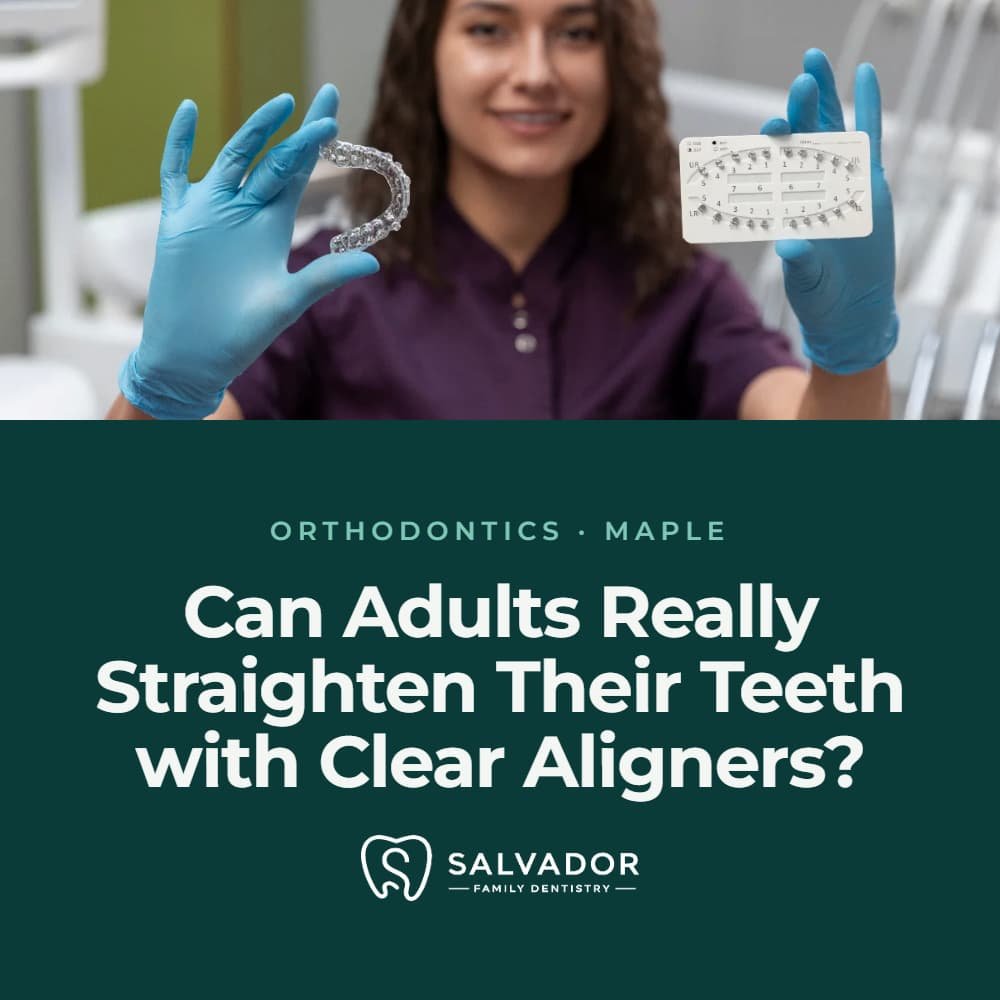
Clear aligners for adults can provide an effective and discreet teeth-straightening option for many people, reflecting a broader trend of more adults pursuing orthodontic treatment generally, but your eligibility depends on your oral health and orthodontic needs. These removable, nearly transparent trays gradually move teeth into position and offer an alternative to traditional braces, though, as with any orthodontic treatment, a professional assessment is what determines whether they’re right for you.
Quick-Answer Verdict
Clear aligners for adults can gradually straighten teeth using a customised sequence of removable trays.
They may address mild to moderate crowding, spacing, and certain bite problems.
Clear aligners are not suitable for every orthodontic condition, particularly when complex tooth or jaw movement is required.
Treatment success depends heavily on wearing the aligners for the recommended number of hours each day.
A dental examination and personalised treatment plan are required to determine eligibility, treatment length, and expected results.
Clear aligners can be effective, but individual results and treatment requirements vary from person to person.
How Do Clear Aligners for Adults Straighten Teeth?
Clear aligners use a planned series of customised trays to apply controlled pressure and gradually move your teeth into their intended positions.
The typical process involves a dental examination and eligibility assessment, digital scans or impressions of your teeth, personalised orthodontic treatment planning, creation of a sequence of aligner trays, wearing each set for the prescribed period, changing to the next set according to instructions, attending regular progress appointments, and wearing retainers after active treatment. Some patients may also need tooth-coloured attachments, enamel contouring, or other supporting procedures as part of their treatment plan; this isn’t the same process or schedule for every patient.
Clear aligners for adults straighten teeth by applying controlled pressure through a customised series of removable trays. Each tray guides the teeth through a planned stage of movement until the intended alignment is reached.
Who May Be a Candidate for Clear Aligner Treatment?
Suitable candidates are generally adults with healthy teeth and gums, appropriate alignment concerns, and the ability to follow the prescribed wearing schedule.
A potential candidate may have mild or moderate tooth crowding, have spaces or gaps between teeth, have certain mild or moderate bite problems, have teeth that shifted after previous orthodontic treatment, want a removable alternative to fixed braces, be committed to wearing the trays consistently, be able to attend progress appointments, and have realistic expectations about treatment.
Your dentist will also assess tooth decay, gum health, existing restorations, missing teeth, bone and supporting tissue health, jaw and bite relationships, and any previous dental or orthodontic treatment. Untreated cavities, gum disease, or other dental problems may need to be addressed before aligner treatment begins. Our routine check-ups and cleanings team can help with that first step if needed.
Who can use clear aligners for adults? Generally, adults with healthy teeth and gums, an appropriate orthodontic concern, and the ability to follow the daily wearing schedule, but this is confirmed only through an examination, not a checklist.
What Dental Problems Can Clear Aligners Address?
Clear aligners may correct several alignment and bite concerns, depending on their type and severity.
Potentially treatable concerns include crowded teeth, gaps between teeth, mild or moderate overbites, certain underbites, crossbites, open bites, crooked or rotated teeth, and teeth that have shifted after previous orthodontic treatment.
Having one of these concerns doesn’t automatically mean you qualify for aligner treatment. Your tooth position, bite relationships, and the complexity of the required movement all need to be evaluated as part of adult orthodontics planning.
Clear aligners may address crowding, gaps, crooked teeth, and certain bite problems. Their suitability depends on the severity of the condition and the type of tooth movement required.
How Long Does Clear Aligner Treatment Usually Take?
Clear aligner treatment time varies considerably. Your dentist should provide an individual estimate after assessing you and preparing a treatment plan.
Factors affecting treatment time include the severity of crowding or spacing, the type of bite problem, the number and complexity of required tooth movements, your age and biological response, the consistency of your daily aligner wear, whether attachments or refinements are needed, your attendance at progress appointments, and whether trays are damaged or lost.
Not wearing your aligners as instructed can delay progress and may require adjustments to the treatment plan. We won’t promise a universal treatment duration here, since it genuinely depends on your case, as your dentist notes: treatment time depends entirely on the complexity of your case.
What Are the Benefits of Clear Aligner Treatment?
Clear aligners appeal to many adults because they’re discreet, removable, and compatible with many everyday activities.
Potential benefits include a nearly transparent appearance, removability for meals, easier brushing and flossing than with fixed braces, no metal brackets or wires, fewer food restrictions when trays are removed correctly, customised treatment planning, convenience for many professional and social situations, and digital planning that helps you understand the proposed treatment.
Removability is both an advantage and a responsibility. Aligners only work as planned when you wear them consistently, which supports teeth-straightening goals but requires real commitment on your part.
The potential benefits of clear aligner treatment include a discreet appearance, removable trays, easier oral hygiene, and fewer food restrictions. Patients must still wear and care for their aligners consistently.
Are Clear Aligners Suitable for Complex Orthodontic Problems?
Clear aligners may treat some complicated cases, but they’re not appropriate for every complex orthodontic problem.
Cases requiring additional assessment may include severe crowding, significant tooth rotations, large bite discrepancies, complicated jaw relationships, teeth requiring substantial vertical movement, impacted teeth, cases requiring extractions, and significant skeletal concerns.
Depending on your situation, you may need fixed braces, a combined treatment approach, referral to an orthodontist, additional dental procedures, or another professionally recommended treatment option. No single clear-aligner system or treatment is universally superior; the right choice depends on your case.
Clear aligners may help with some complex orthodontic concerns, but severe tooth or jaw problems may require fixed braces, specialist care, or a combined treatment approach.
What Should Adults Know Before Starting Clear Aligner Treatment?
Successful treatment requires consistent wear, appropriate cleaning, regular dental appointments, and long-term retention.
Before beginning treatment, understand that aligners usually need to be worn for most of the day and night as instructed, trays should be removed when eating, only water should generally be consumed while trays are in place, teeth should be cleaned before aligners are reinserted, aligners require regular cleaning, temporary pressure or tenderness may occur, speech may take a short time to adjust, attachments may be placed on certain teeth, lost or damaged trays may affect progress, refinement trays may be required, and retainers are normally necessary after active treatment.
Worth asking about upfront as part of your orthodontic treatment planning: total treatment fees, what the quoted cost includes, payment options, progress appointment frequency, replacement tray fees, refinement policies, retainer costs, and expected treatment duration.
Before starting clear aligner treatment, adults should understand the daily wearing schedule, cleaning requirements, appointment commitments, treatment costs, and need for retainers after treatment.
How Can Adults Care for Their Clear Aligners?
Recommended care practices include rinsing aligners when removing them, cleaning them using the method your dentist recommends, storing trays in their protective case, brushing and flossing before reinserting aligners, keeping aligners away from excessive heat, attending routine dental check-ups and cleanings, and contacting the practice if a tray is lost or damaged.
Avoid using hot water on your aligners, since heat may distort the trays, and steer clear of harsh chemicals, abrasive toothpaste, or unverified home-cleaning methods.
How Do Clear Aligners Compare With Traditional Braces?
Here’s a balanced comparison. Neither option is always better, and the right one depends on your case.
| Consideration | Clear Aligners | Traditional Braces |
| Appearance | Nearly transparent trays | Visible brackets and wires |
| Removability | Removable as instructed | Fixed to the teeth |
| Oral hygiene | Can be removed for brushing and flossing | Cleaning around brackets requires additional care |
| Food choices | Removed for meals | Some foods may need to be avoided |
| Compliance | Requires consistent patient wear | Works continuously because the appliance is fixed |
| Suitability | May suit many mild to moderate concerns | May suit a broader range of complex movements |
| Adjustments | New trays and progress assessments | Wire and bracket adjustments |
| Retainers | Usually required | Usually required |
The appropriate option depends on your dental condition, treatment goals, and ability to follow instructions.
Conclusion
Clear aligners can provide an effective and discreet teeth-straightening option for many adults, potentially addressing crowding, spacing, and certain bite concerns. Successful treatment requires consistent daily wear and proper oral hygiene, and clear aligners aren’t appropriate for every orthodontic problem. A consultation is necessary to determine your eligibility, likely treatment time, and expected results.
Interested in straightening your teeth without traditional braces? Book a clear aligner consultation with Salvador Family Dentistry to receive a personalised assessment and learn which treatment options may be appropriate for your smile.
Salvador Family Dentistry is a general dentistry practice serving Maple, Ontario. Dr. Luca Salvador is a general dentist, not an orthodontist; more complex bite corrections may be referred to a specialist.
Frequently Asked Questions
Do clear aligners for adults really work?
Clear aligners can move teeth effectively in suitable cases when worn as instructed. Results depend on case complexity, treatment planning, and, importantly, how consistently you wear them each day.
Are clear aligners for adults effective?
They may be effective for mild to moderate crowding, gaps, and certain bite concerns. More complex cases may require a different or combined treatment approach, which your dentist can discuss with you.
Who can use clear aligners for adults?
Potential candidates generally need healthy teeth and gums, an appropriate orthodontic concern, and the ability to follow the daily wearing schedule. An examination confirms whether you’re a candidate; this isn’t something to self-assess.
How long do clear aligners for adults take?
Treatment time varies based on the type and severity of the alignment problem, the amount of movement required, and how consistently the aligners are worn. Your dentist can give you a personalised estimate.
Are clear aligners for adults comfortable?
Clear aligners are designed to fit closely over your teeth, but temporary pressure or tenderness may occur when beginning treatment or changing trays. Persistent pain should be discussed with your treating dentist.